

Interview with Hideyuki Iwata
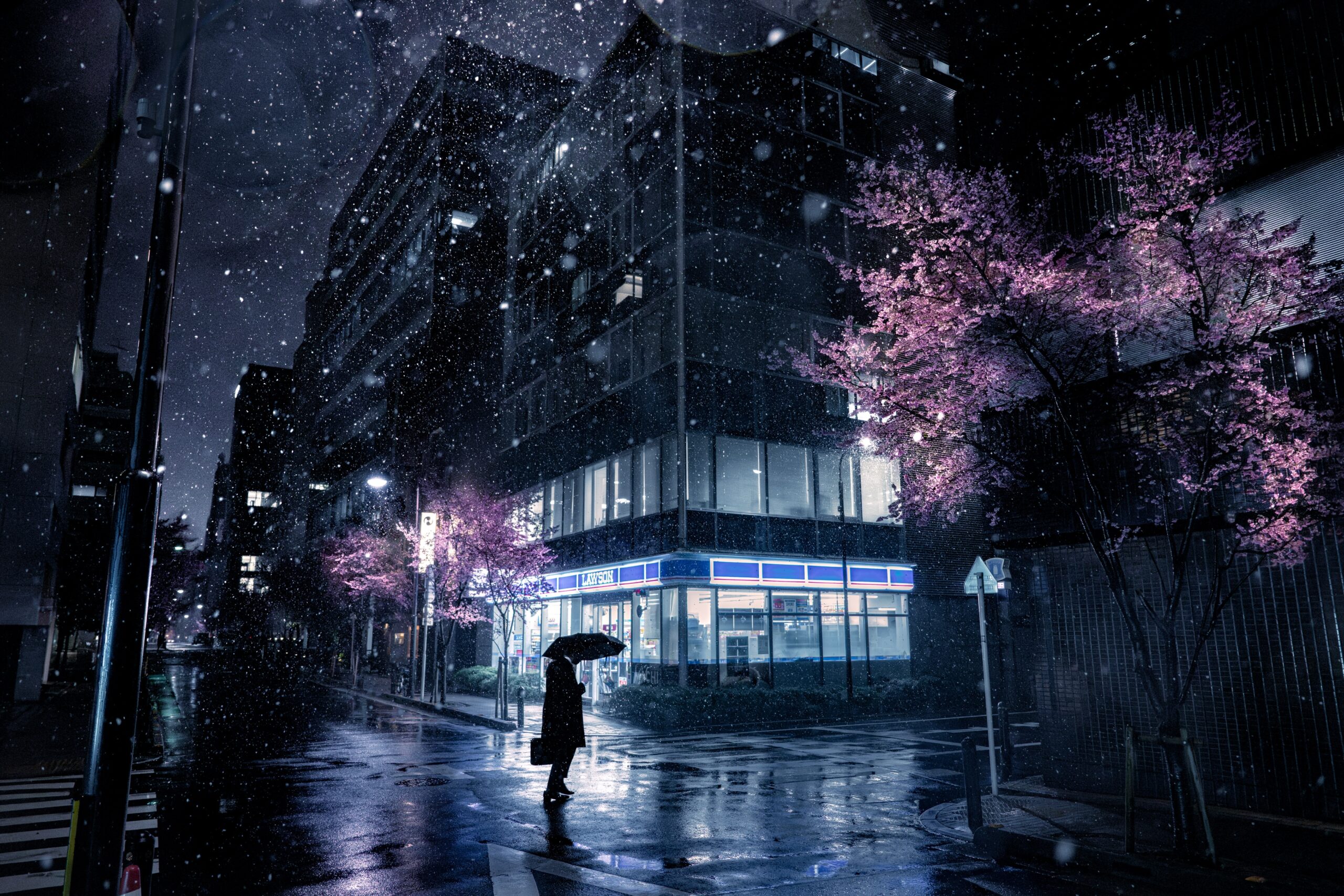
BIFA 2025 Winner, 1st Place, Non-Professional Special, “A Spring Snow Night in Tokyo”
Q: Can you tell us a bit about your background? What inspires you as a photographer?
Alongside my work as a full-time office employee, I photograph everyday scenes in Tokyo as well as the landscapes of the Hida region, which is one of my roots. Photography began as a personal interest, but last year I started entering photo competitions, and this year marks my first award.
My inspiration for street photography does not come from extraordinary events, but from moments in daily life that quietly stir my emotions. These feelings are deeply connected to my own experiences.
The passersby in this work are office workers leaving their workplaces around 9 p.m. on a weekday. I believe my ability to notice and empathize with their state of mind comes from having shared similar experiences myself.
Q: How did you approach capturing the subtle emotions of passersby without interfering with the scene?
Snow and cherry blossoms are both familiar sights in Japan, but encountering them at the same time is extremely rare—especially in Tokyo, where snowfall itself is uncommon.
When I noticed office workers passing through this district without paying attention to this fleeting scene, I felt there was an opportunity to express their inner state through the photograph.
In recent years, people in Japan have become increasingly sensitive about being photographed by strangers. For this reason, I prioritized keeping a distance that would not make passersby aware of the camera, while also ensuring that individuals could not be identified.
Compositionally, I sought a balance in which the contrast between snow and cherry blossoms intersects within the frame, surrounding the passersby, while carefully choosing a position where the streetlights softly illuminated the falling snow.
Q: How did you decide on your technical settings, and what challenges did they present?
To capture the snow suspended in the night air, I needed to raise the shutter speed to 1/400, which made it challenging to secure sufficient exposure and manage high-ISO noise.
However, I judged that the snow filling the frame would naturally reduce the visibility of noise, and that it would not become a major obstacle to the expression.
With this in mind, I focused on maintaining a balance between noise and detail, while prioritizing the elements I most wanted to convey in this work—the snow, the cherry blossoms, and the passersby.
Q: Winning Special Photographer of the Year is a major milestone. What does this recognition from BIFA mean to you personally and professionally?
Being selected as Special Photographer of the Year is a great honor for me, and I am deeply grateful for this recognition.
What began as a hobby has gradually become a lifelong pursuit. I often find myself wondering whether my photographs and my work as a photographer might, even in a small way, connect to someone’s smile or sense of joy.
This achievement has given me a sense of trust as a photographer and feels like a strong encouragement, opening new possibilities to engage with people through photography.
I hope to value this opportunity, continue deepening my expression, and challenge BIFA again next year.
Q: For photographers seeking to capture subtle, fleeting urban moments, what advice would you give about patience, observation, and technical preparation?
Encounters like the rare combination of snow and cherry blossoms can strongly draw a photographer’s attention.
However, I believe it is important to pause and carefully observe the people around you, and to reflect on how their presence resonates with your own everyday emotions.
When a feeling you can genuinely empathize with becomes clear, what truly matters within the photograph begins to reveal itself naturally. In such moments, you may discover an expression that is uniquely your own.