

Interview with Ágnes Dudás
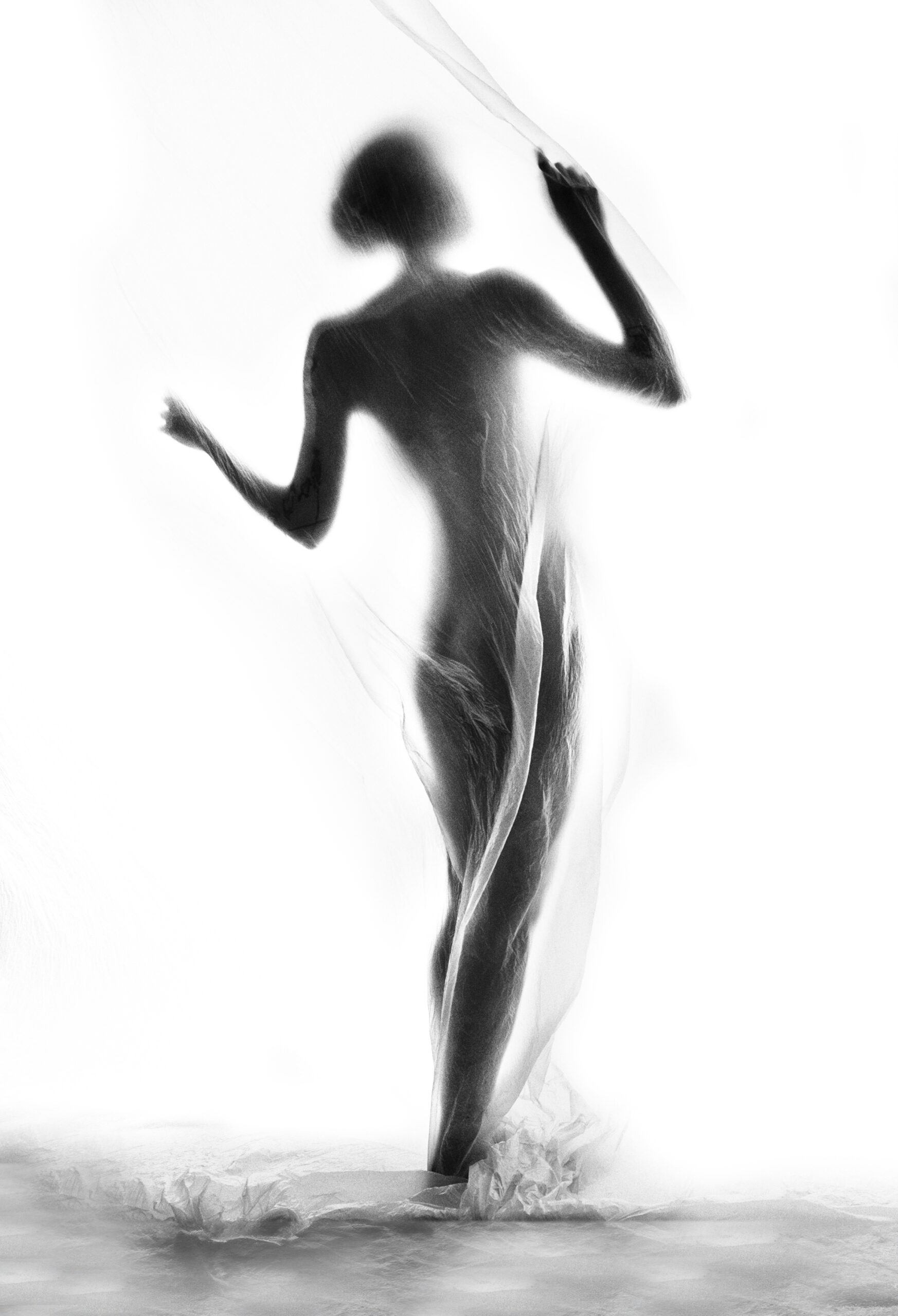
BIFA 2025 Winner, Discovery of the Year, and 1st Place, Non-Professional Fine Art, “Graphite Pencil Drawing Drafts”
Q: What was the specific inspiration behind Graphite Pencil Drawing Drafts? How did the idea of using crumpled foil to mimic a sketch first come to you?
For some time, I have been interested in examining the connections between drawing, painting and photography. I have been seeking the way of achieving a drawing-like outcome using the tools of photography. I previously experimented with various materials, placing the model behind, but for this one, not a transparent foil or extra thin paper-like material work best, but a special thin material that preserves the traces of creasing.
Furthermore, it is quite important to me that an aesthetic female body is present in this series of mine with beautiful movements.
Q: As a graphic designer and a photographer, how does your background in design influence the way you “see” and construct an art portrait like your winning work?
As a graphic designer, I have always thought in pictures, so when I discovered photography, the composition and visual design did not cause difficulties, they almost came naturally. I felt as if I had just got a different tool in my hand instead of a pencil or a brush. After a while, the classic portrait representation did not satisfy me anymore, I wanted to create something different, something that was unique and especially fits in my style. In a way, I am also in these pictures.
Q: You mentioned your favorite themes include abstract and art portraits. What do you feel this specific technique allowed you to express about your subject that a traditional, clear portrait would not?
My art portraits mostly try to imitate the tools of graphic design or painting by the techniques I use. I am not sure that these techniques offer more or better than a traditional portrait, but, in my case, they are more suitable forms of self-expression for me. My images mostly display my own internal subjective perceptions of the world, people and my environment.
I did not only experiment with achieving an effect like a drawing, but I also sought the connection between painting and photography in my several earlier photo series. For these, I used transparent foils, on which I painted additional features matching the model’s clothes and face, and created the image with a single exposure.
For my abstract images, I do not use such a technique, but I love experimenting in those as well. I really like trying new things and materials, for me it is a great game. These abstract photos are often macro shots that show a special world, such as flowing oil-water drops, or photos of resin objects that I have colored and cast. What I enjoy most in oil-water photos is that they only record a momentary reality that is constantly changing. This way, every single picture becomes a unique, unrepeatable creation.
Q: As a photographer from Budapest, what does it mean to you to win “Discovery of the Year” at Budapest International Foto Awards for such a creative and conceptual piece?
I feel very honored that BIFA selected my work for the Discovery of the Year award this year. I have received 2nd and 3rd place and Honorable Mention several times in this competition, but I have not even expected to receive such a great recognition. This award confirms that the artistic path I am on is a good one and motivates me to keep on it. I hope this award will give the opportunity that my works can reach out to wider circles of people.
Q: Beyond the foil, what was the technical setup? Was there a specific lens or lighting arrangement that you found was essential to creating the sharp, “pencil-like” textures?
Lighting played a significant role in achieving the effect of pencil drawing. A white paper background was behind the suspended giant foil, and I illuminated the space behind and in front of the foil with a constant light, a softbox. During the shooting, the position of the lights and the amount of light reaching the foil changed. The strong light coming from behind, along with the use of a wide aperture, eventually “burned out” the parts of the foil next to the model that, so, looked like the blank white paper in the photo. The light reaching the surface of the extremely crumpled foil emphasized its texture, which, in the outcome, created the illusion of pencil strokes.
The foil with this crumpled structure fitting snugly on the model’s body achieved the effect as if the model herself was drawn with a pencil. By changing the position of the light, the shadows of the model also appeared on the foil, creating exciting distortions in some images. The 24-70 mm lens itself had just the role in the series to satisfy all my needs with its good aperture during the shootings.